

Dark Stories Online: How to Play Black Stories Solo
What dark stories and Black Stories are, how the yes/no game works when you play online alone, and eight dark puzzles to start with.
A woman goes to funeral after funeral. She has no obvious reason to be at any of them. That is the entire setup, and somehow it is enough to keep a table of adults arguing for half an hour.
That is a dark story. Short premise, ugly implication, and an answer you have to dig out with yes/no questions. I am not going to tell you the answer here. The fun is in the digging.
If you have searched for black stories online and ended up on a page in another language, this is the English version of that page. Same genre, same rules, slightly different name.
What counts as a dark story
A dark story is a lateral thinking puzzle with a body in it. Not always literally, but usually. Death, crime, betrayal, an accident that should not have happened. The setup sounds ordinary until you notice what is missing.
The mechanics are identical to any other lateral thinking puzzle. One person knows the full story. Everyone else asks questions that can be answered yes, no, or irrelevant. You win when you can explain the whole thing, not when you guess a single word.
What makes it dark is tone, not structure. A puzzle about a man who forgets his umbrella can be solved with the same questions as a puzzle about a man who dies in a locked room. The locked room just stays with you longer.
The best dark stories are quiet. They do not need blood on the walls. They need one detail that refuses to fit, and a solution that makes the whole scene rearrange itself in your head.
Black Stories, dark stories, and the naming problem
The name Black Stories comes from a German card game that came out in 2004. Small black box, one scenario per card, the solution printed on the back. You read the front to your friends and let them interrogate you.
The format was perfect for parties. No board, no pieces, no rulebook to argue about. Just a card and a group of people willing to be disturbed.
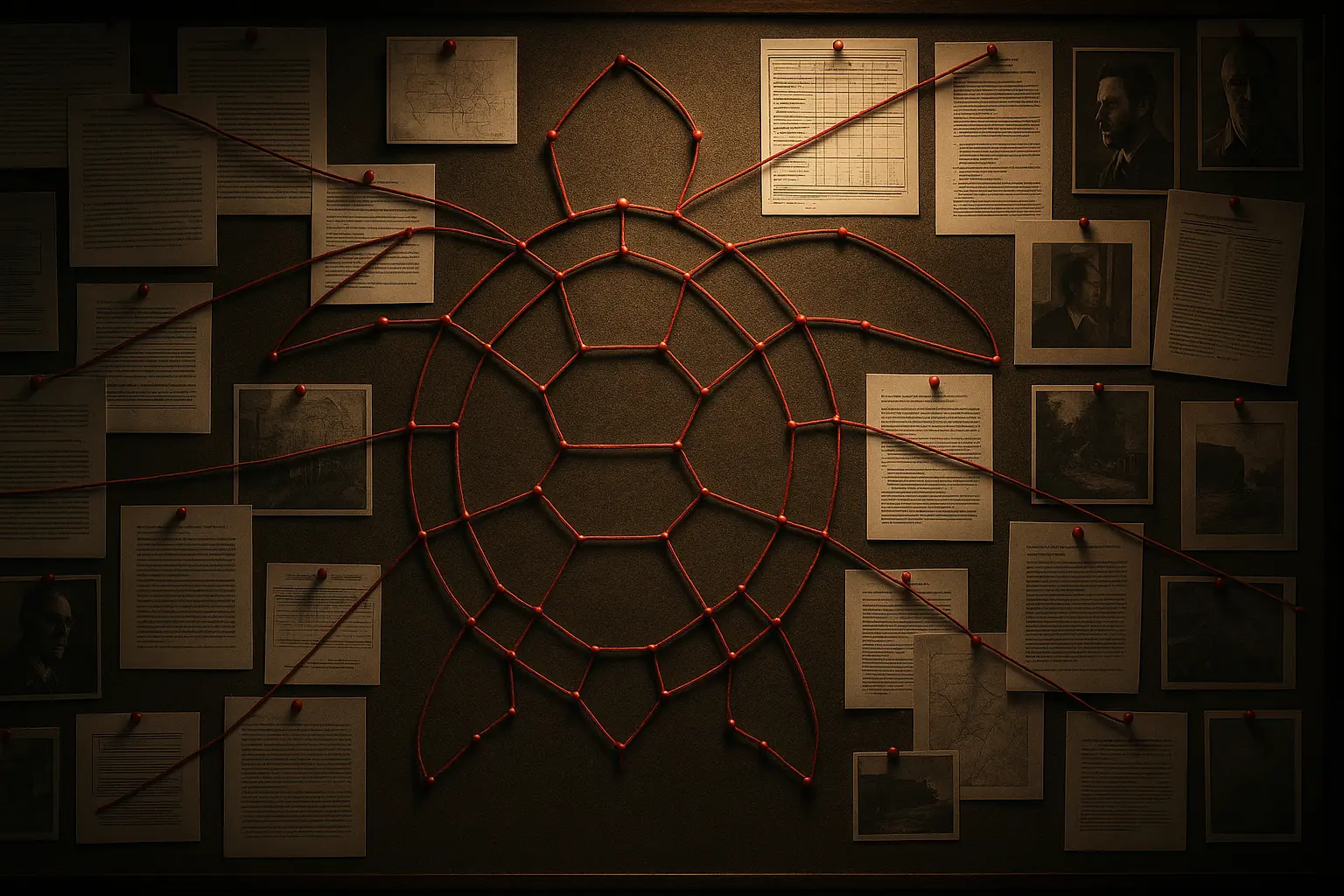
The game spread, the name stuck in some places, and did not stick in others. In English, people say "black stories," "dark stories," or just "those creepy yes/no puzzles." In Japanese, the same idea lives under the name umigame no soup. In Chinese, it is turtle soup. Different names, same engine.
So when you search for dark stories online, you are not looking for a different game. You are looking for the same game with a different label. That is worth knowing, because most of the good puzzles are filed under one name and most of the good explanations under another.
One more thing about the name: a Black Story does not have to involve the supernatural. Some of the strongest ones do not. Ghosts are easy. A chain of ordinary human decisions that ends in something terrible is much harder to guess.
Why the format works online
The original game needs a host who knows the answer and a group who does not. That is a social arrangement, and it is the reason the game used to require a room full of people.
Online, the arrangement changes. The host can be software. The group can be one person. You lose the shared gasp when everyone works it out at the same time, but you gain something else: you can sit with one puzzle for an hour without anyone getting bored.
There is also no performance pressure. In a group, you ask a question out loud and everyone hears it. If it is a bad question, people notice. Alone, you can ask the same thing five different ways and nobody sighs.
The puzzles themselves survive the move online because they are text. A scenario is three sentences. The answer is a paragraph. You do not need graphics, sound, or a table.
How to play dark stories online by yourself
The loop is simple.
- Open a puzzle. You get the scenario and the difficulty. Nothing else.
- Type a question that can be answered yes or no. "Did the death happen before the story started?" is a question. "Why did it happen?" is not, because the host cannot answer it with one word.
- Read the answer. Yes, no, or irrelevant. All three are information.
- When you think you have the whole story, explain it in your own words. A single guess is not enough. The host needs the chain of events.
The host in this setup is an AI. It holds the solution and answers only what you ask. It does not hint, and it does not get tired. That matters more than it sounds. A human host eventually slips, either by hesitating before a "no" or by saying "interesting" a little too warmly. The AI just answers.
The trade-off is that you have to be disciplined. Nobody is going to stop you from asking forty useless questions. The puzzle will wait.
If you have never played this way, start with something short. A difficulty 2 puzzle with a one-sentence setup will teach you the rhythm faster than a five-paragraph epic.
Eight dark stories to start with
I picked these because the premises are clean and the solutions are not cheap. None of them rely on a pun you either see immediately or never see at all.
The Frequent Funeral Goer — difficulty 3. The setup from the top of this page. One sentence, one woman, too many funerals. A good first dark story because there is almost nothing to look at, which means you have to ask about the right things.
Mirror Image — difficulty 2. A woman looks in a mirror and knows she is doomed. That is the whole puzzle. Short enough to finish in one sitting, strange enough to keep you thinking afterward.
High Heels in the Snow — difficulty 3. A woman in high heels, eyes covered, an umbrella in the snow. The image is doing most of the work here.
Suitcase — difficulty 3. A woman opens her suitcase, sees what is inside, and kills herself. One object, one reaction, and no explanation.
Sealed Room — difficulty 3. A body in a foggy room that was sealed from the inside. The door opens and there is no killer anywhere. A classic setup with a very specific answer.
The Little Red Dress — difficulty 4. Her sister chooses a red dress for her. She wears it to school. That night, she comes home to a dead body. Family, clothing, and timing, all in three sentences.
The Shooting — difficulty 3. A man dies in an intense shooting without being hit by a bullet. The setup is one sentence, and every word in it is arguable.
Ominous Dust — difficulty 4. Van Helsing is found dead beside a coffin, and the curtains near the coffin are open. A gothic setup with a solution that does not need the character.
If eight is too many, pick one and give it twenty minutes. Dark stories reward patience more than speed.
The question habits that matter most
Most people start with the crime. "Was she murdered?" "Was there a weapon?" "Did the husband do it?" Those questions feel productive because they sound like detective work. They are usually too specific too early.
Start wider. Is the story realistic? Is anyone actually dead? Is the timeline in the order it is told? Is the narrator a reliable person? These four questions cost almost nothing and they eliminate entire categories of answer.
Then look for the anomaly. In a dark story, the anomaly is usually a detail that seems decorative: a pair of shoes, a closed curtain, the fact that nobody called the police. Ask about the detail that does not need to be there. That is often where the solution is hiding.
Ask questions where both answers teach you something. "Was the woman rich?" is fine if money matters. "Was the woman wearing a hat?" is a waste unless you already suspect the hat. Before you type, ask yourself what a "no" would tell you. If the answer is "nothing," do not ask.
Finally, say your theory out loud as a question. Not "Is it because of the inheritance?" but "Did the brother kill the father for the inheritance, and did the sister find out?" A compound theory gets a useful answer. A vague hunch gets a vague no.
And when you are stuck, question the frame. Is the narrator human? Is the "school" a school? Is the dead person actually dead? The setup only tells you what it tells you. Everything else is your assumption.
FAQ
Are dark stories the same as Black Stories?
Mostly, yes. Black Stories is the name of the German card game that popularized the format. "Dark stories" is the generic English term people use for the same kind of puzzle. The rules are the same: one hidden solution, yes/no questions, explain the whole story to win.
Do I need other people to play?
No. The original game needs a host, but an AI host replaces that role well enough. You can play alone, at any hour, without explaining the rules to anyone.
Can I play black stories online for free?
You can open a puzzle and start asking questions in the browser. No download, no setup, no need to find a host. The site has a credit system for AI questions, so heavy play eventually costs something, but you do not need to pay to find out whether you like the format.
How long does one dark story take?
Anywhere from five minutes to an hour. Difficulty 2 puzzles often fall apart in ten or fifteen questions. Difficulty 4 and 5 puzzles can take a full evening, especially if you refuse to guess.
Why does the host say "irrelevant" instead of "no"?
Because "no" would tell you the opposite is true, and sometimes neither answer is right. If you ask whether the woman's hat matters and the hat is not part of the solution, "irrelevant" is more accurate than "no." Treat it as permission to drop the thread.
If you want the full background on the genre, the history of lateral thinking puzzles covers where these games came from. If you prefer your puzzles without the bodies, start with situation puzzles instead. And if the detective framing is what appeals to you, the yes no detective game is the same engine with a different coat of paint.
Author

Categories
More Posts

Lateral Thinking Puzzles with Kids: What Actually Works
Kids play these differently than adults — messier, more creative, and sometimes better. Here's what to expect and which puzzles to start with.
I Asked 47 Questions and Still Failed. Here's What I Learned About Solving Lateral Thinking Puzzles.
Real tactics from someone who got humbled by a 6-year-old over a puzzle about a hanged man and a puddle of water. No textbook theory, just what actually works.

Playing Lateral Thinking Puzzles Alone, at 1 AM, Against a Robot
Solo puzzle solving has a different rhythm than group play. No audience, no schedule, no one to impress — just you and an AI that never gets tired of your questions.
Newsletter
Join the community
Subscribe to our newsletter for the latest news and updates